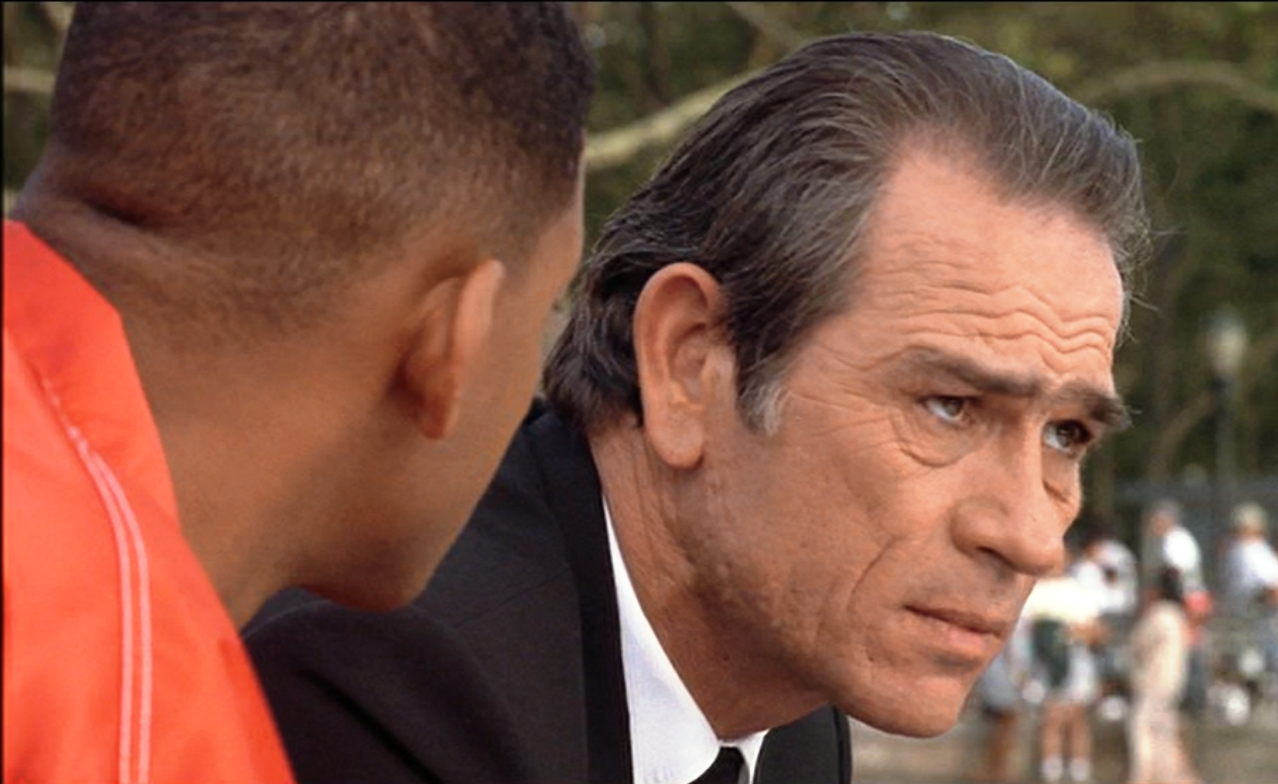
“Fifteen-hundred years ago everyone knew the Earth was the center of the universe. Five hundred years ago, everybody knew the Earth was flat. And fifteen minutes ago, you knew that people were alone on this planet. Imagine what you’ll know tomorrow.” Agent K to future Agent J, Men in Black
No, I’m not advocating for the idea that space aliens live among us. The humorous quote above merely illustrates how our understanding of the world changes as more information is made available. Science is dynamic and ever-changing. True science is an open-ended endeavor of discovery. A scientist needs to be able to follow evidence to a conclusion impartially. They must accept that what the evidence seems to point to today may be different than what facts and evidence may point to tomorrow. That does not seem to be the approach to science that we see today.
There is first of all a pervasive materialistic view of science. Many modern scientists believe that if something can’t be explained in material terms, it simply doesn’t exist. This is fallacious but wide spread. For example, in God’s Undertaker, John Lennox talks about Aunt Matilda’s cake. The chemist can analyze the ingredients, the physicist can analyze the baking process. No one but Aunt Matilda can tell us why she baked the cake. To find that out, we have to ask her. Material explanations work for the observable ‘hows’, but cannot address the philosophical ‘whys’. Material terms cannot explain things like consciousness either. That means there are whole realms of research that a materialist scientist must deny or ignore. They must ensure that their results do not point to a non-materialist conclusion. This severely limits their research.
The pseudo-science of today only makes things worse. We are told to trust “The Science” without considering that “The Science” may be faulty, or at best is only “The Current Science”, and our understanding may change with new information. This phrasing is often used to stop the conversation or close off alternative possibilities. You are a moron or denier or worse if you don’t accept what you’re told by self-proclaimed authorities. Recent scandals involving top rated research institutions in Stanford and Yale universities turn out to be the tip of the iceberg for exposing bad science and falsified data. In his book Science Fictions, Stuart Ritchie (himself a researcher) outlines many research scandals, and identifies some of the many perverse incentives that cause otherwise good people to publish bad and sometimes harmful scientific works.
“We can’t simply marvel at new scientific advances, because we know that the solid, replicable findings come to us alongside a glut of erroneous, biased, misleading and falsified research.” Stuart Ritchie. Science Fictions: How Fraud, Bias, Negligence, and Hype Undermine the Search for Truth
Ritchie is not the only one calling out bad science. Environmentalists Michael Shellenberger in Apocalypse Never and Bjorn Lomborg in False Alarm point to the poor use of science and data to advance unhelpful agendas. Good and useful science is brought under suspicion.
With the generally poor handling of the Wuhan virus pandemic among other things, faith and confidence in science is shrinking among common people and highly educated alike. The scientific community needs to do some housekeeping. Perverse monetary and political incentives need to be removed. Science needs to get back to truly following research where it leads. It must be done honestly and with integrity, and not to advance a personal agenda, ideology or political goal. If true science cannot be revived, the scientists will be primarily responsible for making science ring false in the future.
It is important as the consumers of ‘popular science’, we need to understand the limits of science and the perils of human nature. We rely on science for a better future, but we need to avoid falling into the scientism trap (only material explanations count), or accepting the belief that the assertion that something is scientific makes it unquestionable. We also need to break the false idea that science is a static thing, that once something is established, that’s it. Let’s work to become more knowledgeable and less gullible so we can spot bad science and hold bad scientists accountable.
 Random Thoughts
Interesting Steve
LikeLike